Showing posts with label american herring gull. Show all posts

Sunday, 11 March 2012

AX3T in Rotherhithe

I had two NTGG birds today - both 1st-winter Herrings - including this bird AX3T that enjoyed the Tesco value bread I lobbed out for it: -
AX3T
Spookily, at the tip yesterday, it just so happens that the only 1st-winter Herring Gull I took photos of was AX4T just as it had been ringed and processed...
AX4T
So let's see where and when today's bird in Rotherhithe was ringed. I don't think there'll be any surprises though!

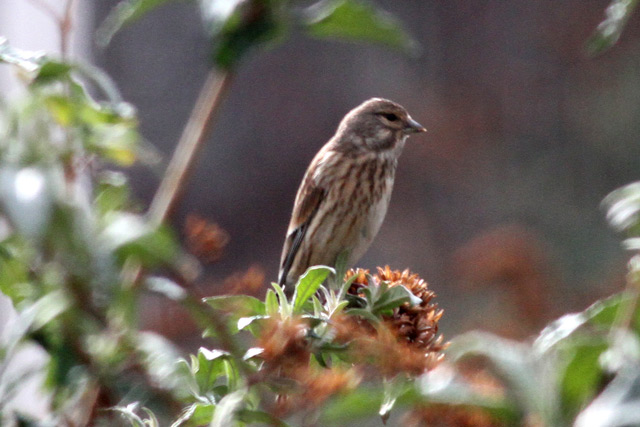
Stayed local as you can tell, doing a check of Rotherhithe. It felt like spring, just without the migrants... although local birds such as Robins, Wrens, Dunnocks etc were in full voice. A couple of Linnets were back on territory near the doctor's surgery, a couple of Egyptian Geese were looking typically hideous with the Ring-necked Parakeets in Southwark Park while, sadly, it seems like there has been a general departure of large gulls from the river.
Local Linnets - an increasingly rare breeder in Inner London
One of the undoubted joys of London birding. Or not.

Friday, 20 January 2012

(S?)AHG at Nimmo's Pier

I've got one of those stinking head colds, feel dog rough and my head is banging. So what do I go and do - decide to have a punt at the Nimmo's Pier adult smithsonianus - a bird I've seen almost annually in recent years.

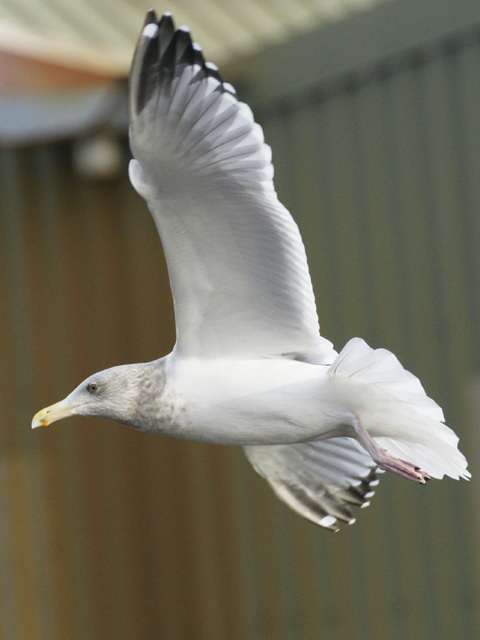
This bird hasn't come back yet this winter (though it wasn't seen until 5th February last year), but it's interesting to look at this bird in the light of what I saw in Ontario, the Corvo bird in October 2011, the Adriaens & Mactavish article and then some correspondence I've been having with a Canadian guller Kevin McLaughlin. Here are some shots (the first two are mine, and I'd like to thank Tom Cuffe for the four excellent flight shots): -
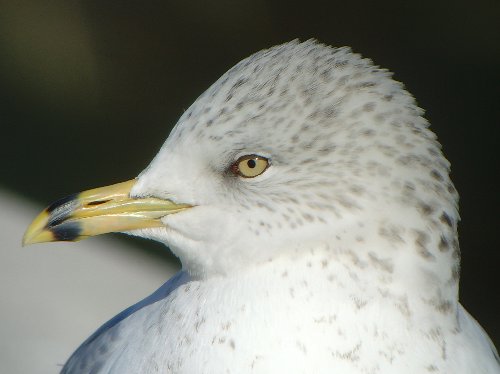
Photo 1. adult American Herring Gull, Nimmo's Pier, Galway, Ireland March 2008; note the heavy rather blotchy head and neck shawl

Photo 2. It was a big, bulky bird in the field; this shot shows a nice P10 mirror, with an extensive black tip and no obvious signs of a pale tongue on the inner web of this feather either (which you'd be looking for on a 'classic' Newfoundland bird) 
Photo 3. A small mirror to P10 on this photo, as well as a subterminal black 'U' to P5

Photo 4. There's an obvious lack of any pale tongue to the outer primary, P10.

Photo 5. Another photo that illustrates the lack of a pale tongue to the underside of P10, and shows nicely the subterminal 'U' on P5.

Photo 6. Note the solid black to the webs of P8-P10. You'd be expecting much more extensive grey inner webs to P8 and P9 on classic Newfoundland birds.
So what do all these features mean? Well, you're never going to be able to know for sure but there are a couple of things that go against this bird being a classic Newfoundland bird: -
- the lack of a pale tongue to P10
- one mirror on P10 only
- the inner webs to the outer primaries (P8-P10) are wholly dark with no obvious grey bleeding through, which is an obvious feature of Newfoundland birds.

Compare Photo 6 with this bird I took in Ontario in December 2011: -
Photo 7. Pretty similar in extent of black on P8 to P10 compared to the Nimmo's bird, with no grey bleeding through on the inner webs to the outer primaries
And then Photo 5 with this bird from Ontario too: -
Photo 8. Note the similar mirror to P10 and also the similarity of the darkness extending down on P10.
So what is the Nimmo's Pier bird. Is it a 'southern' American Herring Gull i.e. a bird from the Great Lakes? You can only speculate of course, but the feedback from Canadians on the Nimmo's bird is that it shows an outer wing pattern very much like the prototype AHG that breeds in Hamilton [Ontario]... and shows an average sized mirror confined to P10. It most certainly does not resemble a typical NAHG (Newfoundland type)'.

Though I'm sure some stuff about this bird has been written somewhere else on the web, perhaps this is of interest. In conclusion, this bird doesn't fit a classic Newfoundland bird (NAHG) - it doesn't exhibit that pale inner web (tongue) to P10 a la Caspian Gull - and if it hadn't been tracked throughout its life (having first turned up as a juvenile in 2004), then I imagine it would have slipped through the net.

Thanks to Kevin McLaughlin, Derek Charles and Tom Cuffe.

Saturday, 14 January 2012

SAHG

Photo 1. The adult culprit, Corvo, October 2011
You may remember back in late October I posted about a ‘Herring Gull’ that I saw on Corvo. Expert commentary on this came from Peter Adriaens, co-author of the seminal paper on adults in a European context (pdf of it here) – and he was helpful and honest as ever.
Peter concluded that there was nothing wrong for it being an American Herring Gull, but the lack of a Casp-like long pale tongue on P10 immediately reduced the chances of reliable identification. 69% of Newfoundland birds ('northern' American Herring Gulls, NAHGs) showed this feature in the sample that his article is based on. Pro AHG features included the all black outer edge to P10 (not broken by the white mirror) and the thin black W pattern on P5; as well as some bayoneting.
Photo 2. Note the leading edge of the wing is black, not broken by the P10 mirror and there is no mirror on P9. 90% of SAHGs show no mirror in P9 just like this. Keep reading...
I bloody said it at the time to Arthur when we saw the bird ‘I bet this is an American Herring Gull, it feels like one, looks like one but reckon it’s not one of those classics so we’ll never 100% clinch it’. And so I was right. This was not a pale-tongued NAHG that you could do for sure.
Photo 3. Still looks a real brute alongside this 1cy atlantis Yellow-legged Gull
So, I kind of left it at that, relatively happy that I’d remain unhappy with the predicament of being closer than close but never a cigar. Roll on December 2011 and a Canadian trip. Here I met up with some local gullers, and this is where my eyes really started to open. These guys watch AHGs all the time, know them inside out - better than us Europeans claiming expert status on sporadic trips/internet birding - and just like we make calls on argentatus and argenteus, it’s possible to make judgements on SAHGs (Great Lake birds) and NAHGs in the field. Interesting stuff.
Photo 4. adult SAHG, Toronto, December 2011; a classic individual, if not with a sightly larger than average white mirror in P10 that extends onto the leading edge of wing. Look at underside of P10 where the black extends way down the primary shaft, with no inkling of that casp-like pale tongue.

Photo 5. Compare the upperside of this bird's left wing (P5 to P10) with that of photo 2. Looks pretty bang on to me.
Kevin McLaughlin has really helped me out and I’ll be eternally grateful for this. SAHGs normally either show a wing pattern of a variable mirror on P10 (sometimes breaching the outer web) OR occasionally a mirror on P10 and a smaller mirror on P9, and a nice subterminal band on P5. The SAHGs in Toronto/Niagara also tallied with what Adriaens and Mactavish said about these birds compared to the Newfoundland NAHGs – ‘shorter grey tongues to P8-10, often no white mirror on P9 (in 90% of those examined), usually a complete black band on p5, and some black on p4 in quite a few birds. All birds had an uninterrupted black band between the white mirror and tip of P10.’
Photo 6. The exception rather than the norm - a SAHG with mirrors on P9 and P10, the latter extending across both webs.
Photo 7. An example of a SAHG with a black marking in P4; it seems as though this bird has dropped P6
Adriaens and Mactavish went on to say that SAHGs appeared smaller, with shorter legs, less sturdy bills, and more rounded heads than Newfoundland birds. So, what with these SAHGs not showing a pale square-ended tongue to the underside of P10 like your classic NAHGs, in a European context you’re more or less f*cked to be able to pick these boys out than brutish NAHGs?
Photo 8. Short-legged and variable head streaking. What I did find was that SAHGs leg colour was consistently bubblegum pink unlike the variability we see in European birds. Compare to photos 1 and 3.
I’ll come to that in a few days... or has a SAHG already occurred in Europe? It's certainly a less than classic NAHG. Have a look here and: -
Photo 9. The regular Nimmo's AHG. Any chance this bird would have passed the test if it hadn't been tracked? I'm currently looking for some underwing shots in flight, so if you have any please email me.

Monday, 26 December 2011

Local Bully Boys

Hope that everyone that reads this has had a decent Christmas. Having got back from Toronto late on 23rd, I spent a few hours on Christmas Eve doing the neglected patch before getting amongst it with wrapping the presents. Anyway, I'd promised some of my Canadian friends a few 1st-winter (European) Herring Gull shots so that they'd provide a decent like-for-like on the smithsonianus we saw together at Niagara a couple of days previously. All these shots taken on 24th December.
A particularly advanced pale individual; note the frosting of the greater-coverts straight to the bases. Lacks the often dark bases that you see in smithsonianus

A fairly dark, relatively immature individual perhaps emanating from a more northerly latitude. But plumage wise, a typical bird - note the shelling on the tertials protruding well towards the base.
 
Dark underwing coverts, but argenteus and argentatus generally lack that velvet smooth texture to the underparts that smithsonianus show. Also note the distinct lack of an all dark tail and palish undertail-coverts.
A near-adult, though the head streaking is just that - it's not blotching. Those legs just don't get close to that bubblegum pink I saw in all the Niagara smithsonianus. In flight, dark area on primary-coverts suggested a 4cy.
Other than these gulls, the patch was really quiet with the lack of cold weather. Just the usual suspects around, and even the Mediterranean Gull did a no show in a brief look on the lake at Burgess Park.

Saturday, 24 December 2011

Last Day with the Niagara River Gulls

Thursday was my last day in Canada, as I'm sitting here on my sofa in London having travelled back earlier today (Friday). I must say that, for a brief week long trip on what I would term a 'non-birding holiday', it was brilliant. Toronto and the Niagara area had copious amounts of the stuff I'm really into (such as gulls) backed up with phenomenal numbers of waterfowl that I don't see any old day back here in London.

My final day was spent with a group of Ontario and Buffalo birders who spend much of their time in larid heaven on the Niagara river. I learnt a hell of a lot with them on Thayer's Gulls, Kumlien's and the different populations of American Herring Gulls - much more than what us Europeans can do by just thumbing through the good old identification articles and odd lone individuals. I'll do some more stuff on this sometime soon.
Anyway, my day was spent at a few spots along the Niagara river. Sir Adam Beck (pictured above) is the place for large gulls, and a site where I saw at least two Thayer's Gulls (an adult and a second-winter) and half a dozen Kumlien's Gulls. There was an adult Little Gull just upriver at the Whirlpool in amongst the copious amounts of Bonaparte's Gulls, while the wall at Chippawa is the other decent site for a bit of large larus action - have a look at this bad boy below to get you going...

If I was on the Thames (which obviously I wasn't), I'd be putting this down as a hybrid Herring x LBB; and that's kind of (well, AHG x LBB) what I assume this bird is too with LBB Gull numbers having increased dramatically in Ontario in recent years - I only saw a third-winter bird (looked like a typical graellsii in mantle colour and structure/bulk). So this hybrid bird was evidently darker mantled than all the smickers, its legs a tepid yellow (with a hint of flesh too), pale iris, head streaking like a LBB and a relatively pronounced tertial step.

There literally are 1000s of American Herring Gulls to scan through, and although variable one thing that really did strike me was that the feet were a real rich bubblegum pink in all adults, without exception - much more standardised than the array of leg colour you get through argenteus and argentatus. The birds are distant, but here are a few smickers for now.
Galaxy smooth...

A 'classic' 2nd-winter - look at that all dark tail, retained greater-covert bar and dark secondaries. A monster like this wouldn't have any problems this side of the pond.

They don't all look like this by the way, despite what we're led to believe. This is a very extreme example
It wasn't all gulls, though it nearly was. I managed to see a couple of Dark-eyed Juncos and an American Robin while looking through the gulls. And a quick stop off at some feeders in Chippawa produced White-breasted Nuthatch, Red-bellied Woodpecker, Downy Woodpecker and American Goldfinch - all good Nearctic fare for me. But if it's one species I'll remember the Niagara river for, it's those tern-like small gulls and I got my fill again.
Finally, I would just like to extend my thanks to the expert knowledge and hospitality that all the birders showed during the trip - Jean Iron was fantastic throughout and along with Willie D'Anna, provided me with plenty of info pre and during my trip; their knowledge of the gulls was immense too, along with Ron Pittaway, Betsy Potter, Declan Troy and Kevin McLaughlin - who I could have talked all day with regarding AHGs. Thank you all, and Karen really appreciated the way you looked after her too.

L to R: Betsy, Jean, Ron, Willie, Declan, me and Kevin

Thursday, 15 December 2011

The other side of the pond

I'll soon be heading off for a week's trip to Ontario - visiting Toronto and Niagara. I'm looking forward to another winter trip to North America, just like when I went to New York in January 2009. It'll be good to get my eye in on some bits and bobs larid wise too before it kicks off over here, though the juvenile American Herring Gull at Baltimore, County Cork has already got me in the mood. There were an impressive dozen species of gulls at Niagara the other day, so hoping I'll get a look in with some of these bad boys - Kittiwake, Bonaparte's, Little, Franklin's, Ring-billed, American Herring, Thayer's, Kumlien's, Glaucous, LBB, GBB and a single Slaty-backed Gull.

It won't be a hardcore birding trip, and sometimes it's good to mix it up a little bit. In fact, it will just be nice to be in good health as when I was in NY a couple of years back I got a bit of a bug that had me done over for a day, and then feeling pretty grim shady for the rest of my days there. Anyway, here are a few I prepared earlier (New York, 2009).
American Herring Gull (photos 1 to 6)


Ring-billed Gull (1st winter)

Ring-billed Gull (adult)

Pale-bellied Brent

Snow Goose (1st-winter)

Hooded Merganser

Pied-billed Grebe

American Robin

Song Sparrow

White-throated Sparrow

Sunday, 27 November 2011

Rotherhithe regulars

Between the 50 or so books that I had to mark today, I did manage to squeeze in a bit of local larid action. It wasn't as if I was targetting this genus, it's just the way it goes around here. It's basically gulls or bust, except when there's a freeze up, and especially on a day like today when there was little point looking for passers in Russia Dock Woodland due to the wind.
Black-headed Gull, Greenland Dock

Herring Gull, Greenland Dock
Basically, I saw very little - and even went to King George V dock on the other side of the river for a quick look. Had a pleasant time in the blustery conditions, taking shots of the commoner species, and got frustrated with a red-ringed 1cy Herring that just wouldn't play ball for detailed ring reading (presumably a Rainham/Pitsea bird). The aythya flock up to c.50 now, though still pretty poor given it's almost December but a sign of the mild conditions to date. All pretty mundane stuff, especially with the news of Gary Speed. Had a nice McFlurry on the way home to round things off.
Common Gull, Greenland Dock

Wish you were here? Yep, I do... but a shame it was just one of the many sails on the boats on Greenland Dock just outside my flat this a'noon.