Friday, 22 August 2014

Gulls on the beaches of North Carolina

Nearly a week back, and it doesn't take long for normal life to take hold. GCSE exam results have meant I've been in school every day this week. But with the Azores on the horizons, and the larid memories still fresh, here are some photos from the beaches of North Carolina - from around Hatteras Landing and Kill Devil Hills.


juvenile Laughing Gulls, North Carolina 9th and 10th August 2014


adult Laughing Gulls, North Carolina 9th and 10th August 2014

juvenile Ring-billed Gull, North Carolina 10th August 2014

1st-summer American Herring Gull, North Carolina 9th August 2014

2nd-winter Lesser Black-backed Gull, North Carolina 10th August 2014
I managed a little bit of birding around and about, and bizarrely the grounds of the Wright Brothers Memorial (at Kill Devil Hills) were where I saw the best birds - including Prairie Warbler and Brown-headed Nuthatch. There were a lot of Eastern Kingbirds about, that actually seemed to be on the move, while other highlights included Black-and-white Warbler, American Robin, Willets and Semipalmated Sandpipers. Nothing great, but always nice to see.
adult Semipalmated Sandpiper Hatteras, North Carolina, 10th August 2014

juvenile Eastern Willet, Hatteras, North Carolina 10th August 2014


Tuesday, 19 August 2014

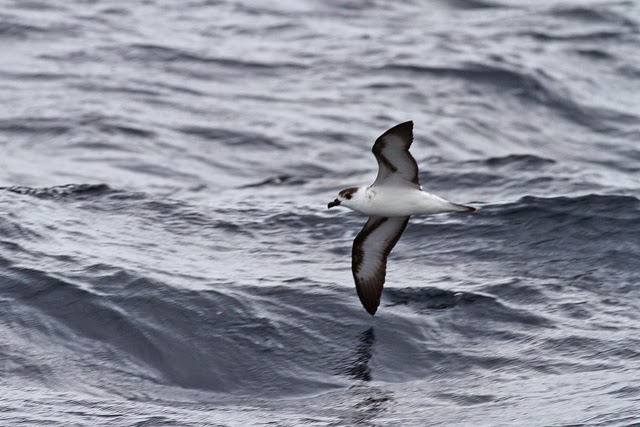
Black-capped Petrel photos from Hatteras

So, this one is a bit different to my recent travelogue posts. So, I'll set the scene - last Saturday, 9th August, I was fortunate to go out from Cape Hatteras, North Carolina with Brian Patteson on 'The Stormy Petrel' in pursuit of pelagic birds. As someone who has done a fair number of different pelagics, this was a professional one with an excellent boat and good use of chum...

However, for me, there was one real purpose of going - to see Black-capped Petrel and study their variability. And for sure, it's a very variable species where I reckon some people may have one extreme - the 'white-faced' individuals - within their search image. I also learnt that Bob Flood and Ashleigh Fisher 'pterodroma petrels' book is bloody excellent too; I knew this as I reviewed it for Birdwatch last year but flicking through ad hoc and then using it with a purpose are two different beasts. What it notes, and I noticed too, are the following macro points on the 40 or so birds that I saw: -
- there is a great array of variability in Black-capped Petrels. I only saw one bird that would fit the 'white-faced' criteria, with all others being 'dark-faced' or intermediate birds.
- underwing is extremely variable, and seems to some extent to be much paler on intermediate and 'white-faced' birds. Though this is just through the one trip I went on.
- they're not like Great Shearwaters at all; though I did go back to the book on one particular 'dark-faced' bird that looked in some respects close to a Bermuda Petrel - though a check of the large bill and the extensive white on the rump/uppertail confirmed it as a Black-capped.
- wing moult varied somewhat; perhaps this being age related. The 'dark-faced' and intermediate birds seen were largely showing some state of wear (inevitable for a non-breeder).
- the birds skirted the boat, sometimes following in the wake loosely. On one occasion, a bird was sat on the sea in amongst Cory's Shearwaters.

All the above is very interesting, with a lot of the Black-capped Petrels seen at a sea depth of c.2,000 feet. Given that all the other species seen, with the exception of Bridled Tern, are regularly seen off the Azores I can but hope to bump into a Black-capped Petrel out there one day. But until I do, here are a fair few photos of this quality species. Recent studies suggest the two types are genetically distinct (probably at subspecies level).
Photo 1. A typical 'black-faced' individual in active wing moult.

Photo 2. Same bird as photo 1 showing what I'd call an average underwing pattern.

Photo 3. A 'dark-faced' individual with a particularly dark underwing.

Photo 4. Probably what you'd call an intermediate morph, though on the darker side. Note the relatively pale underwing and also the dusky half collar on the hindneck.

Photo 5. A 'dark-faced' bird exhibiting wing moult as well as the broad white rump and uppertail.

Photo 6. Same bird as in photo 5; showing the dark cap with a dusky hindneck extending into the mantle.

Photo 7. An intermediate bird, that initially I thought could be a 'white-faced' bird. However, note the dark smudging behind the eye and also slight hindneck markings.

Photo 8. Another photo of an intermediate morph - note the pallid underwing appearance to the true 'dark-faced' individuals.

Photo 9. Another example of an intermediate morph, on the paler side than average but still showing black to the eye, dusky hindneck and heavy wing moult.

Photo 10. Intermediate morph again showing classic underwing pattern and capped appearance.

Photo 11. Perhaps what most people have as a 'classic' Black-capped Petrel - the isolated black cap, obvious white rump and white hindneck.

Photo 12. Same bird as photo 11 - note the slight supercilium on this intermediate bird.

Photo 13. Illustration of a classic pale underwing - little wing moult going on here. Breeding on Hispaniola spans November to May, so perhaps this could be a young bird?

Photo 14. 'Dark-faced' birds especially seemed to be in relatively heavy wing moult.

Photo 15. Another intermediate bird, showing a couple of markings on the hindneck; could well be the same bird as in photo 13 and shows relatively fresh wings.

Photo 16. The facial appearance of this species varies dramatically - some 'dark-faced' birds like this can look rather 'mean' in comparison to their more docile looking intermediate/'white-faced' relatives.

Photo 17. The only truly 'white-faced' bird of the trip. Note almost  a lack of a black cap, the lack of any markings on the hind neck. Also, the theory is that at this time of year adult 'white-faced' birds should be much fresher winged - as in May/June they're often in heavy moult.

Photo 18. Same bird as above, showing the obvious white nape with no dark markings.

Thursday, 14 August 2014

Flagstaff and the Grand Canyon

Having finished up at the Salton Sea, my next mission was to drive for the majority of the day from there to Las Vegas, where Karen would be arriving. The next couple of weeks would be a bird friendly 'non-birding' holiday. Sort of.

So first place on the agenda was Flagstaff; a really pleasant town set up in the pine forests and away from the desert heat. As well as attracting tourists as it's on Route 66, the place is also pretty close to the Grand Canyon - one of those places you must see. Anyway, to the birds - around Flagstaff casual birding produced stuff like Western Tanager, Hairy Woodpecker, Dark-eyed (red-backed) Junco, Mountain Chickadee and Acorn Woodpeckers. Also, with a bit of perseverence I was able to track down a group of Pinyon Jays, a species I'd not seen previously.
Pinyon Jay, Flagstaff
A single Green-tailed Towhee was seen under the chairlift at the Arizona Snowbowl, while at the Grand Canyon (which was pretty birdless to be honest) Western Scrub Jay and a single Black-chinned Sparrow were the highlights.
Dark-eyed Junco, Flagstaff - ssp. dorsalis ("Red-backed Junco")
A bit of target birding always does the trick though. And through research - mainly using Ebird - I'd picked up on a spot for Grey Vireo in an area of junipers to the south of the East Entrance to the Grand Canyon National Park. With some patience and persuasion, I eventually tracked one down - Warbling Vireos and Blue-Grey Gnatcatchers, along with a single Grey Flycatchers and Black-throated Grey Warblers, provided some backup too.

The next three days I spent surviving Las Vegas. An absolutely putrid place, full of the most vacuous and distasteful people on the planet. Not somewhere I think I'd ever enjoy, but for the sake of the holiday somewhere I endured. Completely birdless too, except for the odd Great-tailed Grackle. Time to fly east...

Monday, 11 August 2014

Return to the Salton Sea

I can't quite believe that it was only on New Year's Day that I was here last. However, as with a lot of things that I do these days, there was a specific target - seeing a Yellow-footed Gull. And that I did, pulling out an adult in the pre-roost. One thing I didn't do though was get any meaningful photos and so, with the species being much more abundant in summer, I decided on a return. The best place for birding at this vast, saline environment is the southeast end to the north of Brawley - Obsidian Butte and the area immediately to the southwest was where I spent my time this trip.

adult Yellow-footed Gull
I'll do a more in-depth post some other time on the target species, but suffice to say they were showy enough to get the images and understanding that I wanted. At least 80 birds - mainly adults - part of a post-breeding dispersal northwards from Baja California, Mexico; the Salton Sea's the only reliable place to see the species in the USA. There were also California, American Herring, Ring-billed and a couple of Bonaparte's Gulls too.
American Avocet

Long-billed Dowitcher
As always though, the whole place was absolutely buzzing with birds - loads of Long-billed Dowitchers, Wilson's Phalaropes, Least Sandpipers and Killdeers while infinite numbers of Brown Pelicans (and to a lesser extent White) and Double-crested Cormorants lined the shores. Through in the odd Redhead, Western Grebe, Northern Harrier and Burrowing Owl too - not bad for an afternoon and a morning of gull watching. It was bloody hot though.
Double-crested Cormorant

Osprey

Thursday, 7 August 2014

Last day in southeast Arizona

Southeast Arizona had been very kind to me, and with it being my last full day before I started to head north, I was in a position of being able to target a few species that I'd yet to see - namely Gilded Flicker, Lucifer and White-eared Hummingbirds, Rufous-capped Warbler and Grasshopper Sparrow.

And so I started off in Green Valley shortly after dawn where just to the west of the I-19 (the turnoff to Madera Canyon), some gardens with ornamental Saguaro cacti provided some easy views of a Gilded Flicker. This place was a living cemetery, and as Rich will confess, the look on my face when I walked into the golden arches at 6.30am was a picture - literally tens of 70+ people just sitting about eating their Sausage & Egg McMuffins. Anyway, to the birds...

Rufous-capped Warbler, Florida Canyon
And it was back to Florida Canyon, a site I'd visited in the dead of the afternoon a few days previously. Walking up the canyon, with views of another couple of Black-capped Gnatcatchers, I got in position for where the Rufous-capped Warblers were being regularly seen. Rich said they'd be easy enough but, after over 3 hot hours in the canyon, one eventually played ball and started singing. This Mexican species is now a regular breeder in this canyon - with perhaps up to 4 singing birds this year - and seems to be the best place in the ABA region to regularly see this species currently. Broad-billed Hummingbirds darted about, and a Blue Grosbeak was busy attending to its nest.
Grasshopper Sparrow, Las Cienegas
With the warbler finally seen, Las Cienegas grasslands was the next port of call (after the best burrito of the trip). This steppe-like area was ripe for sparrows - Botteri's, Cassin's and of course some really nice, fairly diminutive Grasshopper Sparrows. A really showy Pronghorn, of the endangered Sonoran race sonoriensis, was quality too.

Pronghorn, Las Cienegas
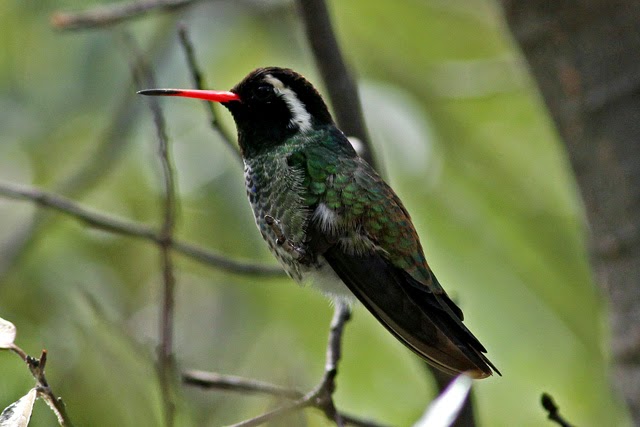
And then it was back to Miller Canyon, with White-eared Hummingbird and better views of Spotted Owl in mind. Luck was with us, and at Beatty's hummingbird feeders the White-eared Hummingbird showed well alongside a host of other hummers - Calliope, Anna's, Black-chinned, Anna's, Magnificent, Broad-tailed and Broad-billed. Mega stuff!
White-eared Hummingbird, Beatty's Ranch
The two young Mexican Spotted Owls were pretty inquisitive up the canyon too: -
Mexican Spotted Owl(et), Miller Canyon
And with an hour or so of light left, we headed to Ash Canyon and the feeders at the lovely Mary Jo's - complete with her African Grey Parrots. This was good timing as a Lucifer Hummingbird (as well as a Lucifer x Costa's Hummingbird) had been coming into the feeders late on in the day; and tonight there wasn't to be any disappointment with firstly the hybrid, and then just before dusk, the Lucifer fed itself up in the twilight.

So, with just a couple of hours sleep (as Rich was doing some guiding for the Tucson Audubon Society) I said my farewells and immense thanks - and headed to the infamous Patagonia Rest Stop where a pair of Thick-billed Kingbirds were lurking in the early morning gloom. These were the last birds of any note I saw in southeast Arizona, an area of immense birding potential and varied landscape. Now  it was just a small drive to that saline spot in southeastern California...
Thick-billed Kingbird, Patagonia Rest Stop

Sunday, 3 August 2014

Borderland birding

A couple of days ago, I visited the Arizona border with Mexico. To the west of Nogales, this wilderness area is heavily patrolled by border agents and some of the stories Rich Fray gave me about his encounters with immigrants there make the whole Mexico/US migration very real. Given that several canyons span the border, inevitably there is some good birding to be had with some species just creeping into these man made boundaries.
Montezuma Quail
To start the day off, there  were some Mexican Cliff Swallows nesting under a bridge near Rio Rico, and more Montezuma Quail action with a male in particular chilling out by the roadside in the early morning light as we headed on down towards Sycamore Canyon. There were also lots of Cassin's Kingbirds, Rufous-crowned and Lark Sparrows as well as a nice juvenile Grey Hawk.
juvenile Grey Hawk
Sycamore Canyon held some nice birds, in particular an Elegant Trogon that perched briefly along with usual bits such as Summer Tanager, Black-headed Grosbeak, Ash-throated and Brown-crested Flycatchers. However, the Mexican mega wasn't to be found and so we headed further west a little way to California Gulch, home of the Five-striped Sparrow. In the midday heat, there were still sparrows singing with at least half a dozen of them. Really nice looking birds, and much darker overall and larger than what I'd expected. Another quality bird for this trip...
Five-striped Sparrow
We headed further down the canyon, and three Purple Martins above us were of the desert subspecies hesperia - these birds nest in cacti and the females in particular are slightly different to nominate birds. There was also a Black-capped Gnatcatcher too, that showed well alongside a couple of Black-taileds in the steaming heat. After eventually leaving California Gulch, the rest of the afternoon was spent doing the loop back north through Arivaca and back onto the I-19. I eventually got some good views of Rufous-winged Sparrow, a new bird for me, while a couple of Yellow-billed Cuckoos and Lazuli Buntings were also noted. On the small pond at Amado, there was a single Tropical Kingbird sallying from the wires whilst unseasonal Ring-necked Ducks and Black-necked Grebes were noted too.

Another decent day in Arizona, and rounded off with a quick walk across the border in the evening to get some food. Thanks again to Rich for the hospitality and the birding.

Friday, 1 August 2014

The Chiricahuas deliver

On 28th July, I visited the Chiricahua Mountains in extreme southeastern Arizona; so much so that to get to them you have to go into New Mexico and then west back into AZ. Anyway, I'd heard mixed reports about the road up there and with a massive thunderstorm overnight I was a little nervy about getting up the apparently steep mountain road. I needn't have worried, as this was a life lesson - Americans are a lot more risk averse in general than me, and they haven't experienced the shite roads I've been used to driving in places like Egypt, Turkey and Morocco. So there was no problem and lots of birds, which started with this nice pair on the way up.
Montezuma Quails - pair by the roadside on the road up the Chiricahuas
Gamebirds aren't my cup of tea usually - non-migratory bits of feather that do admittedly taste decent - but Montezuma Quail is an absolute beauty. They've had perhaps their best year to date, so seeing these two and another male on the drive up the Chiricahuas would be rather unprecedented in any other year.
Mexican Chickadee - Barfoot Junction in the Chiricahua Mountains

And so I continued to the higher elevation pine belt where Mexican Chickadee breeds - this being the only accessible site in the US for this species (apparently they breed in NM on private, inaccessible montane areas too). It didn't take long to find one, and I was fortunate in locating this bird coming to its nest near Barfoot Junction. Heading back down the mountain - with the accompaniment of Sulphur-bellied Flycatchers squeaking away - it was time to visit Paradise. And though it was not what I'd envisage paradise to be in its entirety, The George Walker House feeders (owned by Jackie (and her two dogs)) was pretty nice. I'll do a separate post sometime on the 'feeder culture' of Arizona birding, but suffice to say you'd never get this hospitality in blighty. Anyway, the speciality here is Juniper Titmouse and after an hour or so a couple came down. The wait wasn't bad to be honest, what with stuff like Magnificent Hummingbird, Black-throated Grey Warbler, Bridled Titmouse and Black-headed Grosbeak all showing themselves.
Juniper Titmouse - a rather plain affair
Black-throated Grey Warbler - enjoying a wash at the George Walker House feeders
 The Jasper feeders in nearby Portal had some nice desert species showing themselves off, including Blue Grosbeak, Black-throated Sparrow and Cactus Wren.
Black-throated Sparrow - the archetypal North American desert sparrow

Driving west from the mountains, I stopped off at Cochise Lake for a wader fix where there were over a hundred Wilson's Phals and fifty or so Baird's Sands. And with the intention of getting to Rich Fray's place for the evening, I headed down through Sonoita to Patons in Patagonia - where the staked out Violet-crowned Hummingbirds duly obliged.
Violet-crowned Hummingbird - at the feeders at Patons
I'm now writing this having left Arizona for now, with all target species and more seen (got my gull fix this evening at the Salton Sea - plenty of Yellow-footeds!). Rich Fray was instrumental in doing this, and the re-branded Leicester Llama is now one of the dons of SE Arizona, with an amazing ability to charm the pants off the large numbers of mature birding women about in that neck of the woods. Cheers Rich for letting me kip around yours and showing me the ropes and birds of your adopted home... there'll be more on this soon.